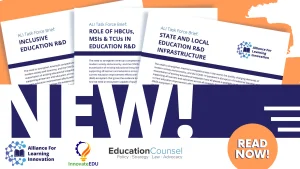
The Alliance for Learning Innovation and Digital Promise have co-authored a new paper that outlines a proposal for a federal competitive grant program that would provide state and local education agencies with the capacity to conduct high-quality research and development (R&D). It argues for Congress to authorize a program that would fund new education R&D initiatives at the state and local levels and improve the efficacy of existing efforts.
What is needed now are creative new ways to accelerate learning and get students back on track. R&D is the engine that drives evidence-based, innovative improvements to teaching and learning. It is also essential for studying the implementation and impact of new approaches; to understand what works, for whom, and in what conditions. Yet most states and school districts conduct virtually no R&D to generate and test new solutions in a timely and community-informed way. SEA and LEA leaders are not incentivized to make education R&D a priority, nor do they typically have the resources or capacity to engage in robust R&D efforts. This leaves states and localities reliant on a patchwork of siloed federal programs that, while valuable, lack the proximity to communities that SEAs and LEAs possess.
A bolder investment in K-12 education R&D, informed by the science of learning, is critical to producing and scaling transformative new approaches and technologies. While there is capacity, infrastructure, and funding (though not nearly enough) for education R&D at the federal level, that is not the case at state and local levels. There is only a patchwork of commitments to R&D at State Education Agencies (SEAs) and Local Education Agencies (LEAs) across the country, leaving huge gaps in America’s innovation ecosystem. Education R&D cannot solely be supported at the federal level, as it is R&D that takes place in closest proximities to communities that is arguably the most nimble, responsive, and effective.
This paper names barriers to achieving a comprehensive education infrastructure across the landscape of state and local education R&D, and offers a policy solution to address them. While the philanthropic, private, and nonprofit sectors can strengthen state and local R&D, this paper focuses on a public policy approach. Specifically, it outlines a federal proposal for a competitive grant to provide state and local education agencies with resources to build capacity for high-quality R&D.
ALI conducts advocacy work thanks to financial support from the Walton Education Coalition (WEC).