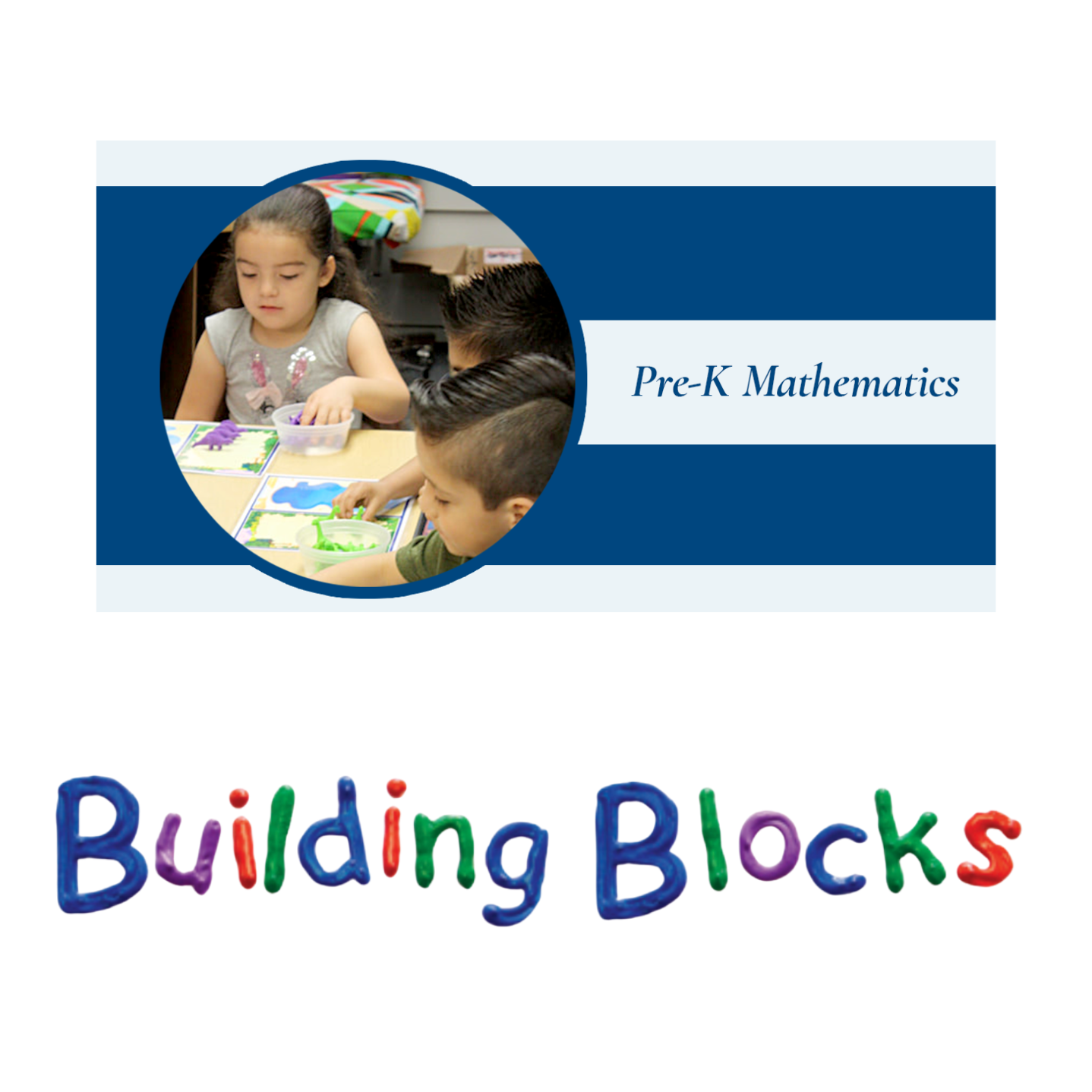
Pre-K Mathematics is a program that develops and builds upon young students’ math knowledge with in-class activities, instructional coaching for educators, and weekly home activities for families to support their children’s learning.
Building Blocks is a pre-K math intervention program that fosters geometric, spatial skills, and numeric and quantitative ideas and skills in young learners.
Students who lack access to high-quality early childhood education are more likely to experience academic struggles, behavioral issues, and even poorer health outcomes in adulthood. With high rates of staffing shortages in early childhood classrooms, there is an urgent need for new approaches to support early childhood educators. Evidence-based tools and programs built for young learners can both support early childhood educators and provide interventions for students before they enter K-12. Pre-K Mathematics and Building Blocks offer examples of research-backed, federally supported technologies that prepare young learners to be successful students.
Turning Education R&D Investments into Impact
Pre-K Mathematics is supporting young learners in math with the support of strategic federal investments in education R&D.
$ 400000
Pre-K Mathematics received:
$400,000 from a Head Start-University Partnership grant
$ 1 million
Pre-K Mathematics received:
$1 million from a U.S. Department of Education grant
$ 15.1 million
Pre-K Mathematics received:
Four IES grants totaling $15.1 million
How Pre-K Mathematics Works
Pre-K Mathematics originated as a set of family math activities developed by Alice Klein and Prentice Starkey at the University of California, Berkeley. Grounded in cognitive developmental theory and aligned with Common Core math standards, Pre-K Mathematics develops and builds upon young students’ math knowledge with engaging, hands-on activities conducted in small groups, two to three times a week. New activities with built-in developmental adjustments are introduced weekly to expand upon students’ previous knowledge. The program provides in-class instructional coaching for educators and includes weekly home activities for families to support their children’s learning.
Pre-K Mathematics’s Impact
In one study, Pre-K Mathematics was found to be effective at enhancing children’s early mathematical learning and development. Another study found that Pre-K Mathematics doubled math gains for students, and that the intervention was effective across variations in geographical sites, program types, and child/family ethnicity.
Further evaluation of the program discovered that children who received Pre-K Mathematics programming increased their scores by more than 100 percent on two separate math exams. And, Pre-K Mathematics is the only early childhood curriculum that has received the highest rating of effectiveness for mathematics in a What Works Clearinghouse review. Now housed within WestEd, Pre-K Mathematics is being implemented across the country.
The impact of these investments is clear:
102 %
Children who received Pre-K Mathematics programming increased their scores by 102 percent.
Building Blocks is supporting young learners in math with the support of strategic federal investments in education R&D.
$ 5.5 million
Building Blocks received:
$5.5 million from National Science Foundation grants
$ 13 million
Building Blocks received:
$13 million from Institute of Education Sciences grants
How Building Blocks Works
Another program that has had success in teaching math to young learners is Building Blocks. Created by Dr. Doug Clements and Dr. Julie Samara in 1998 at the State University of New York at Buffalo (SUNY Buffalo), Building Blocks supports the development of geometric, numeric, spatial, and quantitative skills in young learners by developing activities based on students’ experiences and interests. The Building Blocks team produced a curriculum, a curriculum research framework, professional development resources, and a model for scaling these resources.
Building Blocks’s Impact
The Building Blocks team tested its curriculum and learned that the program improved student performance on the Early Mathematics Assessment (EMA) by 36 percentiles — meaning that a student who scored in the 50th percentile on the EMA before the Building Blocks intervention would score in the 86th percentile on the EMA after using the program.
Another study evaluated the effects of Building Blocks across 120 pre-kindergarten classrooms in New York State and Boston. The researchers found that students who received Building Blocks in pre-kindergarten saw “strong immediate positive effects of the intervention on children’s Research-Based Early Math Assessment (REMA) gains during the Pre‐K year.” These gains were greater than those of children who did not use Building Blocks.
Federal investment supported not only the development and evaluation of Building Blocks, but also the TRIAD Scale-Up project, a large-scale project that explored how to implement Building Blocks across entire school districts.
The impact of these investments is clear:
36 percentiles
Building Blocks was found to improve student performance on the Early Mathematics Assessment (EMA) by 36 percentiles — meaning that a student who scored in the 50th percentile on the EMA before the Building Blocks intervention would score in the 86th percentile on the EMA after using the program.
With federal support, innovative interventions like Building Blocks and Pre-K Mathematics are improving the quality of early childhood education. These evidence-based tools and strategies are laying a foundation for young children’s future success in school and beyond.