Recently members of the Alliance for Learning Innovation coalition attended the ASU+GSV Summit 2024 in San Diego. Members led and participated in sessions about edtech innovations, R&D partnerships, and AI’s place in the future of education. More than 70 practitioners and education leaders joined the session ALI hosted on how state and school district leaders use education R&D to improve outcomes for kids.
Best Practices from Top Education Leaders
In ALI’s session, “Evidence-Driven School System Leadership and the Role of R&D,” a panel of school system leaders discussed best practices and challenges as they work to prioritize evidence-based decision-making. Featured speakers included Penny Schwinn (former Tennessee Education Commissioner); Barbara Jenkins (former Superintendent, Orange County Public Schools, Orlando, Fla.); and Mike Nagler (Superintendent, Mineola Public Schools, NY); with moderator Sara Schapiro (Senior Fellow and Director of Social Innovation, Federation of American Scientists).

Panelists answered questions about how to share bright spots across districts, the components of effective innovation at the state and district levels, and how the education community needs to shift its mindset to allow for greater innovation in education leadership.
“We have to get to a place, to a culture, where it’s okay to fail, learn from that failure, and iterate in schools,” said Penny Schwinn, the former education commissioner of Tennessee.
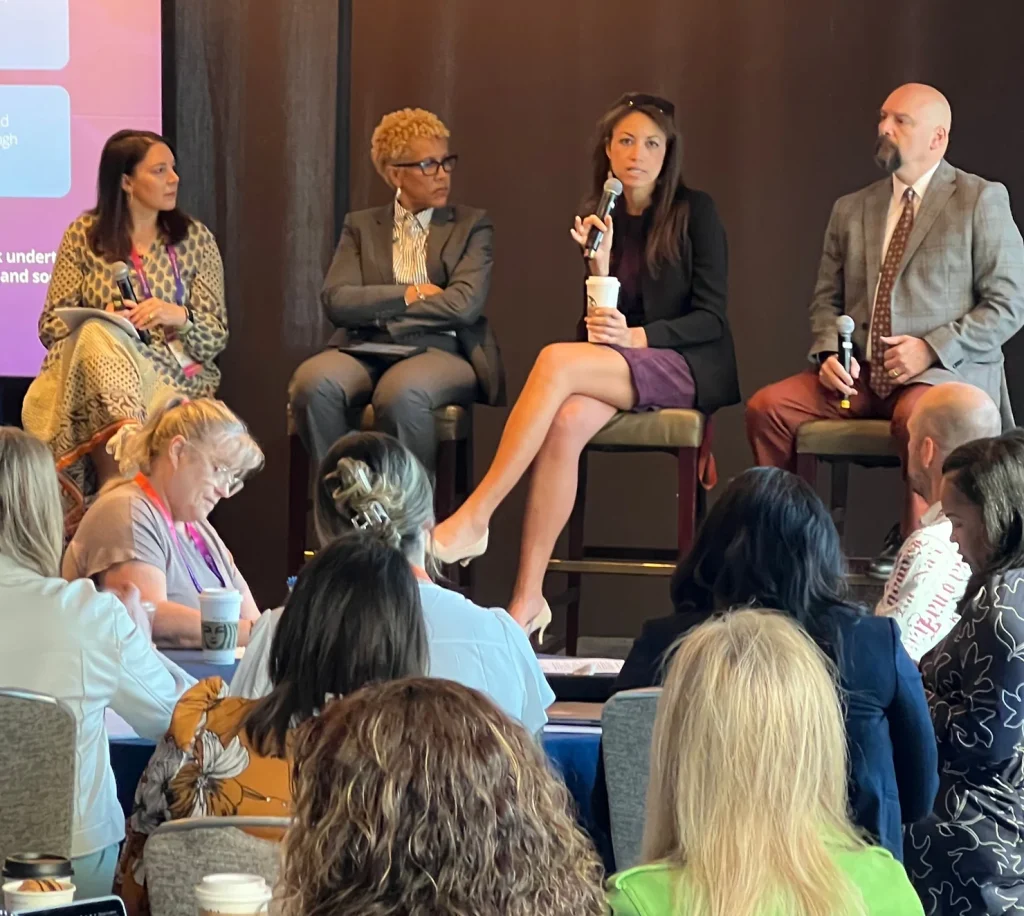
A similar sentiment was shared by Barbara Jenkins, the former Superintendent of Orange County Public Schools. She emphasized the importance of purposeful abandonment.
“If it’s not working, if the data are showing it’s not working, it is okay to drop it,” said Jenkins. “You should get rid of it.”

ALI’s Recommendations for State and Local Education R&D
Following the conclusion of the panel, session attendees discussed ALI’s State and Local Task Force recommendations. Participants recounted the difficulties that schools and districts face when implementing innovative education practices, especially when trying new strategies that might not work. The group also touched on the need for differentiated evaluations when innovating at scale and the importance of including the greater community when deciding to fund and implement new R&D-backed ideas.
To wrap up the session, Sara Schapiro shared a new paper, “How The Next ESRA Reauthorization Could Build State And Local Education R&D Capacity”, co-authored by ALI and Digital Promise. It expands on one of the task force recommendations – to establish a federal competitive grant program that would provide state and local education agencies with the capacity to conduct high-quality R&D.

Continuing the Conversation
ALI members and colleagues made appearances on ASU+GSV stages throughout the week to discuss topics like utilizing AI for opportunity, scaling education innovations, increasing student literacy with edtech, and more. The ALI coalition looks forward to continuing the conversations sparked at ASU+GSV.