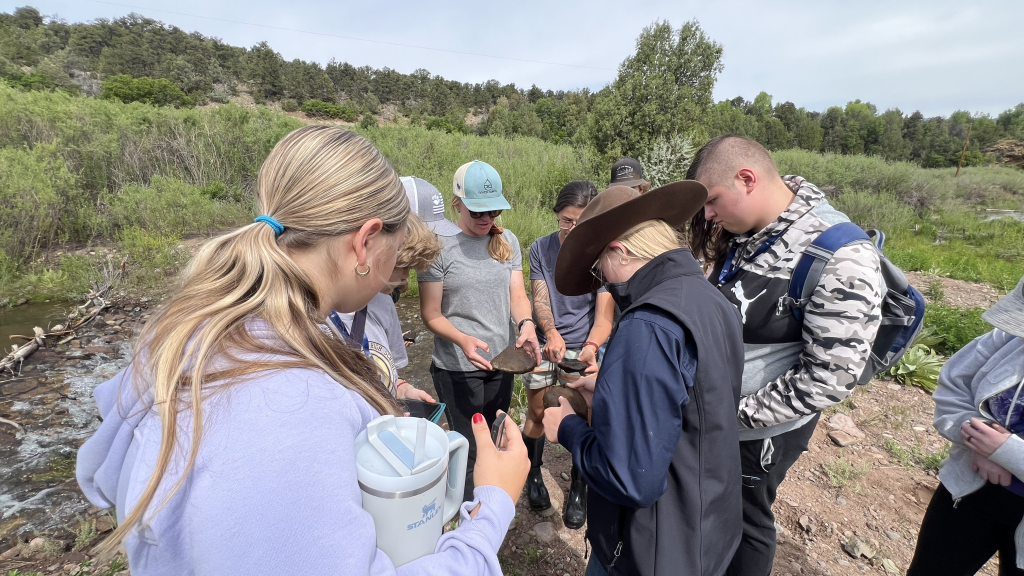
Rural Collaboratives bring rural districts, higher education, and industry partners together to expand postsecondary opportunities, align pathways with workforce needs, and strengthen rural economies. Colorado’s four Rural Collaboratives—Southwest Colorado Education Collaborative, Fremont Multidistrict Initiative, Western Slope Schools Career Collaborative, and Yampa Valley Partnership for Students, Stewardship and Sustainability—were supported by Empower Schools and, through partnership and resource sharing, are better preparing rural Colorado students for the future workforce.
Turning Evidence-Based Strategies into Impact
Colorado is bringing schools, businesses, and government together and sharing information and data to help rural students find better career opportunities.
$ 16.5 million
Since 2020, Rural Collaboratives across Colorado have received $16.5 million in public funding from multiple sources, including funding from the RISE Grant, Rural CoAction Grant, Opportunity Now Grant, and Congressionally Directed Spending.
These investments have resulted in:
4
4 Rural Collaboratives established across the state, serving 7,500+ high school students, with 3 more in design and planning stages.
5
5 existing career pathways strengthened, including in healthcare and construction trades, providing more students access to richer coursework, work-based learning, and industry-aligned credentials.
6
6 new career pathways, including in early childhood education and advanced manufacturing, to meet local labor market needs.
Scaling Success from Texas to Colorado
In 2019, a group of rural superintendents from southwestern Colorado were searching for proven strategies to better prepare their students for life after graduation. At the time, the state had just 52 workers for every 100 open jobs and significant talent gaps in skilled trades, education, and healthcare in rural areas.
These superintendents visited Texas’s Rural Schools Innovation Zone (RSIZ), a partnership that facilitates neighboring rural districts to share resources to expand opportunities to dual credit courses and career pathways.
Empower Schools, a nonprofit that partners with local school systems to implement community-driven solutions, supported the development of the RSIZ in Texas and was well-positioned to help the Colorado superintendents adapt the model to their communities. What followed was Colorado’s first Rural Collaborative–the Southwest Colorado Education Collaborative–which brought together K–12, higher education, and workforce partners to design pathways aligned with local labor market needs.
Since then, rural school district leaders across the state formed three additional Rural Collaboratives–Fremont Multidistrict Initiative, Western Slope Schools Career Collaborative, and Yampa Valley Partnership for Students, Stewardship and Sustainability–creating new partnerships, expanding opportunities, and reshaping what’s possible for students and local economies. This work illustrates how rural leaders can use research findings to redesign systems and better prepare students for the workforce.
“When we work together, our students gain access to opportunities that no single school district could provide on its own. We’ve seen firsthand how shared programs expand options, from industry certifications to concurrent enrollment, and ultimately give students in Fremont County the chance to pursue futures that feel both possible and exciting.”
How Rural Collaboratives Work
Rural Collaboratives are guided by three principles: they are locally driven, built on the strengths of their communities, and designed to last. Instead of relying on short term initiatives, these collaborations create sustainable efforts that expand opportunities for multiple districts at once.
Each Rural Collaborative brings together multiple school districts, industry partners, higher education institutions, and a coordinating intermediary. Intermediaries are a key characteristic of a Rural Collaborative, uniting stakeholders around a shared vision, helping leaders leverage partnerships, and adding the capacity and convening power needed to sustain pathways over time.
Evidence-Based Practices
Every Rural Collaborative integrates three evidence-based components proven to improve student outcomes, all aligned with Colorado’s annual Talent Pipeline Report:
- Industry Recognized Credentials. A study from the Fordham Institute found that students who earn industry credentials in high school have stronger college and employment outcomes.
- Work-Based Learning. A study from Strada Education found that paid internships are linked to higher incomes, confidence, and satisfaction with education and career outcomes.
- Concurrent Enrollment Coursework. A 2017 What Works Clearinghouse Intervention Report and a study from the Community College Research Center assert that dual enrollment increases the likelihood of high school graduation, college access, and degree attainment.
Advancing Data Sharing and Statewide Leadership
One of the most powerful aspects of Rural Collaboratives is their ability to connect systems that previously worked in isolation. They create infrastructure for data-sharing between education and industry, giving leaders the information they need to make better decisions and track outcomes over time. This data-driven approach ensures that pathways are aligned with real workforce needs, connecting students with clear opportunities ahead.
Early Impact: Transforming Student Pathways and Workforce Outcomes
Colorado’s Rural Collaboratives now serve more than 7,500 high school students across the state. Rural Collaboratives are also:
- Expanding and strengthening pathways by enhancing coursework, work-based learning, and industry-aligned credentials.
- Sharing resources to reduce cost, providing access to equipment and materials through gear libraries and shared databases like Career Launch Southwest.
- Streamlining work-based learning by creating talent pipelines that meet regional workforce needs.
To better understand the long-term impact of these efforts, Empower Schools is partnering with Harvard’s Center for Education Policy Research on a longitudinal study evaluating how Rural Collaboratives influence student outcomes post-graduation. The results of this research will be released in the coming years, providing critical evidence to guide policy decisions and future expansions of this work.
Insights from Rural Collaboratives are already influencing statewide action. After seeing the impact of this work, Colorado’s Department of Education set a new vision for postsecondary readiness: every high school graduate will leave with at least 12 concurrent enrollment credits, a meaningful work-based learning experience, or an industry-recognized credential.
This is more than a policy shift—it reflects a data-informed redesign of the high school experience. By grounding decisions in evidence and lessons from early collaborative efforts, Colorado is creating a model for how research and practice can work together to close opportunity gaps and prepare rural students to thrive in their careers and communities.