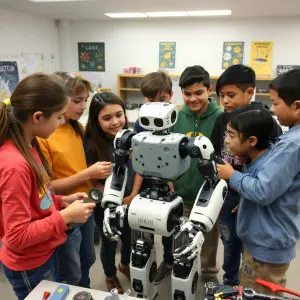
States, districts, and community organizations are expanding career exploration opportunities for middle and high school learners as young people seek stronger support in preparing for future pathways. Earlier this year, Project Evident conducted an assessment of career exploration evidence and practice in the United States. We reviewed research across education, workforce, career, and youth development, and spoke with education leaders, practitioners, and researchers. Our goal was to establish what we know about delivering high-quality career exploration, understand potential gaps, and identify areas for improvement.
What We Learned
- Career exploration should start early and build over time.
Young people begin forming ideas about careers early in life, shaping the choices they make later. By high school, many have already narrowed the careers they consider possible based on how they see themselves, what their families and communities value, and the support available to them. They need continuous opportunities across middle and high school to investigate possibilities, learn by doing, connect with trusted adults, and revise their understanding of themselves and their options as they grow.
- Career exploration is expanding, but students’ experiences vary widely in quality, depth, and coherence.
In surveys and qualitative research, young people describe wanting this same combination of hands-on learning, authentic challenges, relationships, and reflection, but access to these opportunities remains uneven. Many students still experience career exploration as a collection of disconnected activities. A student might attend a career fair or hold a summer job with little help connecting what they learned to their coursework, interests, or future plans. Schools and community organizations need to help students build on these experiences over time, so they leave with a better understanding of their options and how to pursue them.
- The evidence base is promising but still very thin, especially for middle school.
Recent OECD longitudinal research found that several activities during adolescence, including career conversations, workplace visits, and part-time work, are associated with better employment outcomes in adulthood. In the United States, however, the strongest evidence for K–12 career-connected learning is concentrated in structured, multiyear pathway programs, including CTE programs and early college high schools. There is limited but promising evidence that mentoring, project-based learning, work-based learning, advising, and planning support can improve near-term outcomes, including achievement and career awareness.
While existing evidence points to certain activities and practices as ingredients for meaningful exploration, important questions remain:
- How should schools and community organizations bundle, sequence, and deliver different types of activities to create cohesive, high-quality exploration?
- How do different approaches affect students’ beliefs, skills, relationships, and plans? Do these changes predict academic and labor-market outcomes?
- How do implementation conditions— including staffing, training, partnerships, and technology— shape results?
- Which students benefit, and what is required to extend those benefits more broadly?
Implications for Education R&D
Answering these questions will require coordinated investment in research, implementation, and state and local capacity. This aligns with the Alliance for Learning Innovation’s recent recommendations for career-connected learning, including its calls for stronger R&D infrastructure, modern longitudinal data systems, support for implementation, and locally driven research. Our assessment highlighted the need to:
- Align the field on target outcomes and shared measures for quality exploration. Shared measures would help us better compare approaches and examine whether short-term student gains in knowledge, confidence, skills, and social capital lead to better education and employment outcomes. Longitudinal data systems are important to this work, but data on participation and completion are not enough. We also need to understand what students experienced, how often and how extensively they received services and supports, who supported them, and what young people gained from participation.
- Invest in practitioner capacity to deliver quality exploration and continuously learn. Schools and community organizations need adequate staff, training, time, tools, and data systems to deliver quality programs, coordinate school-day and out-of-school experiences, sustain employer partnerships, and act on what they learn. Our recommendation to invest in these conditions and the capacity to test and improve approaches aligns with ALI’s calls for state R&D capacity grants, support for educators and school systems, and a state learning community to evaluate approaches and share findings.
- Support research that answers practical questions about effectiveness. Alongside ongoing improvement, we need rigorous research on clearly defined programs and approaches. Implementation studies, longitudinal research, and outcome evaluations — including causal studies where feasible — answer different questions. Together, they can show whether an approach improves outcomes, explain differences in results, and inform decisions about where and how to expand it.
Summing it Up
Pairing expanded career exploration with sustained state and local R&D capacity can help communities develop, test, refine, and scale promising approaches, and ensure that more opportunities produce meaningful outcomes for young people.