Ever since the No Child Left Behind Act (NCLB) took effect in 2002, student “proficiency” has been a guiding principle of education policy and reform. NCLB mandated that every student in the U.S. reach proficiency in reading and math and, per its very title, that no child be left behind.
One of the most consequential outcomes of NCLB was to transform the National Assessment of Educational Progress (NAEP) from a relatively small-scale testing program into a national assessment of reading, math, and several other subjects on a regular basis. When NAEP publishes its results for states and districts, debates often follow about how to improve student outcomes.
These debates usually focus on average “scale” scores and the “league tables” which rank states on those scores. States that compare well with other states, such as Massachusetts, or that move up the table like Mississippi, claim bragging rights. Indeed, the competitive pressure flowing from these tables probably provides the federal government’s strongest leverage to pressure states to improve their education systems.
In addition to these scale scores, NAEP also measures performance using three achievement levels:
- Basic— Students have partially mastered the skills expected for their grade.
- Proficient— Students have solid command of grade-level material and can apply it to real situations.
- Advanced— Students perform at a superior level.
These three levels of achievement imply a fourth, unofficial one: below NAEP Basic. Students in this group haven’t mastered the basic skills expected for their grade. In reading, that means they struggle with tasks like making simple inferences or finding the main idea in a text.
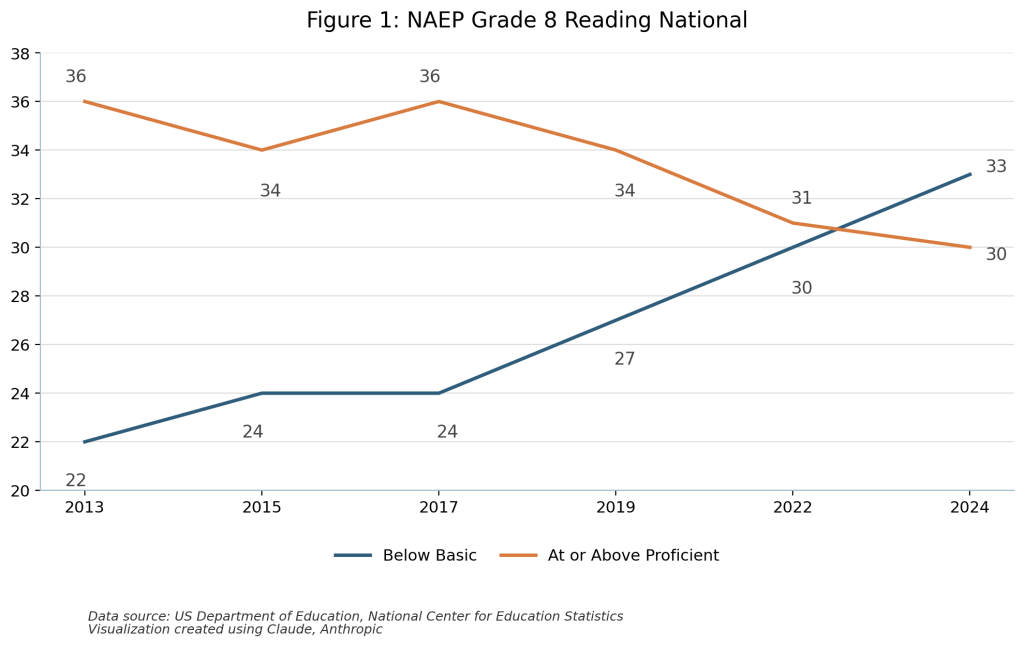
Perhaps the most undesirable side effect of the nation’s decades-long focus on student proficiency is that we have neglected the large and growing percentage of students who score below NAEP Basic in reading. Consider Grade 8 reading, where nationally, the share of students below NAEP Basic has grown from about a fifth of students to a third over the past dozen years, according to the most recent assessment. Simply put, about one-third of American eighth graders have trouble doing simple tasks such as identifying the order of events and finding the main idea in a text (See Figure 1).
Just as state comparisons of scale scores have driven policy, I present the percentage of students below NAEP Basic in grade 8 reading by state in Figure 2, in hopes that it might spur similar attention and policy addressing this aspect of student achievement.
In six states, plus the District of Columbia, over 40 percent of eighth grade students are below NAEP Basic in reading, including New Mexico at 46%, followed by West Virginia, Alaska, and DC at or above 42%. Even as we celebrate the so-called Mississippi Miracle, over one third of Mississippi’s eighth graders are below NAEP Basic in reading.
In states that do well overall on NAEP reading assessments, large percentages of students are still being left behind. In Massachusetts, one of the consistently highest-performing states on NAEP, one quarter of its eighth-grade students are below basic. Similarly, in other high-performing states, such as New Jersey, Colorado, and New Hampshire, one-quarter of their grade 8 students are below NAEP Basic.
Figure 2: Percent of students Below NAEP Basic, Grade 8 Reading 2024
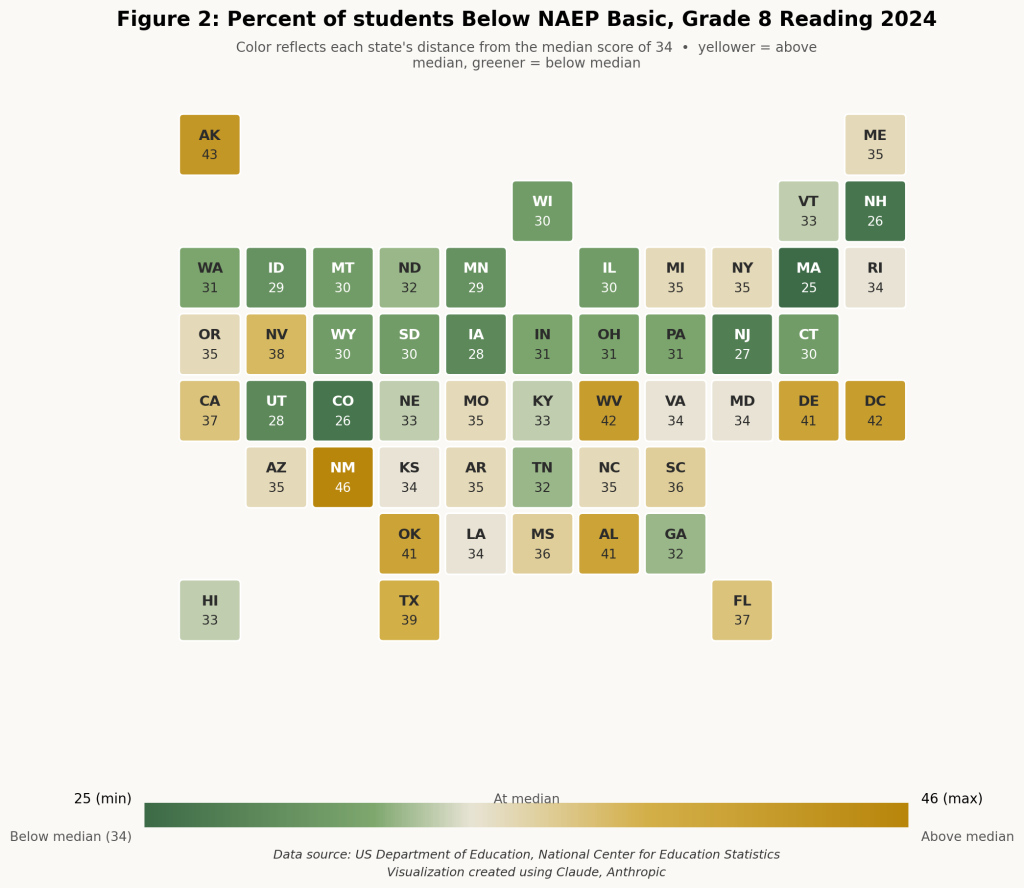
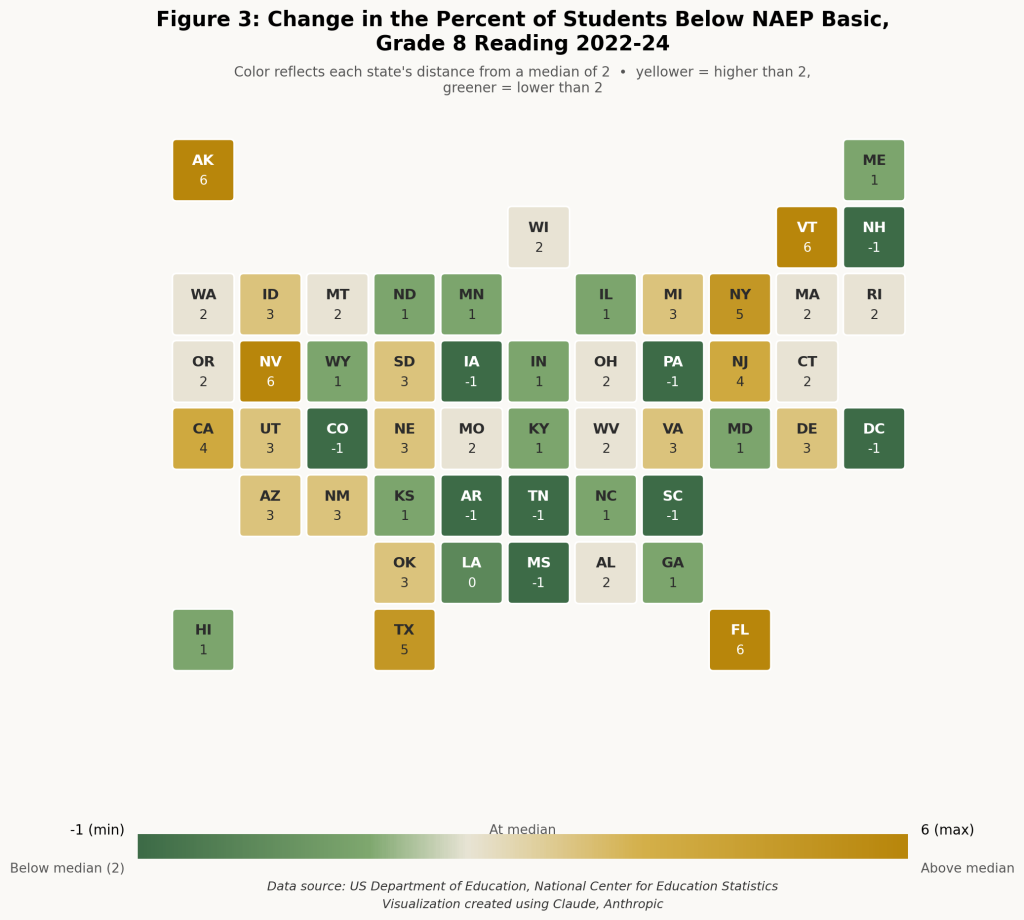
Figure 3 shows the state-by-state change in the percentage of students below basic between 2022 and 2024. The median change was a two percent increase in the percentage of students who were below basic. In yellow states, more students performed below basic; in green states, fewer students performed below basic.
The nation’s largest states, California (+4), Texas (+5), Florida (+6), and New York (+5), all witnessed an increase in the percentage of eighth-grade students below NAEP Basic well above the 2 percent median increase. Only a handful of states decreased the percent of students below basic, and, despite these gains, some of them, such as Arkansas and the District of Columbia, still had large concentrations of students below basic.
Figure 3: Change in the Percent of Students Below NAEP Basic, Grade 8 Reading 2022-24
Taking Action to Close the Gap
Reducing these numbers will take more than good intentions. A few concrete actions could help:
- Extend evidence-based reading instruction past the early grades. Most reading investments and Science of Reading implementation are concentrated in kindergarten through third grade. But the data above shows the problem is just as severe by eighth grade. States and districts need dedicated funding and curricula for foundational reading intervention in middle school, not just the assumption that students arrive already reading on grade level.
- Train middle school teachers to teach foundational reading. Many middle school teachers were trained to teach content, not how to identify or remediate basic reading gaps. Closing this gap means giving them the same kind of training in evidence-based reading instruction that elementary teachers increasingly receive.
- Build better data systems to catch struggling readers early, and track what works. Right now, the country largely learns about this problem every two years, when NAEP results are released. States need stronger, better-connected data systems that let them identify struggling readers year to year, not waiting for the next national assessment, and that let them see whether specific interventions are actually closing the gap.
We Must Pay More Attention to Our Struggling Students
NCLB’s focus on proficiency was needed to pressure states and the nation to improve all students’ learning. But by focusing on proficiency, we’ve left too many children behind, as reflected in the growing percentages of those who score below NAEP Basic. We’re also leaving behind middle school teachers who will instruct a growing number of students who are lacking the fundamental reading skills teachers likely assume their students already have. And we’re leaving the nation behind by not preparing a growing number of students for a future when proficient reading comprehension will set them apart from AI.
It’s time to return to NCLB’s original promise and make sure the students furthest behind are no longer overlooked.